

An Introduction to Mali
Present-day Mali was once part of three West African empires - Ghana, Mali, and Songhai - which controlled trans-Saharan trade. In the late 19th century, during the Scramble for Africa, France seized control of the territory and made it a part of French Sudan. Despite achieving independence in 1960 as the Mali Federation, the country waited until 1992 to adopt a constitution after a long period of one-party rule, becoming a democratic, multi-party state. See full country profile.Latest Research News from Africa
3 current African jobs:
Senior Research Executive - Healthcare, Egypt, Competitive salary - (posted Aug 10 2026)
Research Manager - HEC, Egypt / hybrid, Competitive salary - (posted May 21 2026)

GOVERNMENT: republic
AREA: 1,240,192 sq km
POPULATION: 14,159,904 (July 2011 est.)
MAJOR LANGUAGE: Official Language: French
Some business and general info
The Market Research Industry
Trade and Industry in Mali
A little More Knowledge?
Go to next country
Present-day Mali was once part of three West African empires - Ghana, Mali, and Songhai - which controlled trans-Saharan trade. In the late 19th century, during the Scramble for Africa, France seized control of the territory and made it a part of French Sudan. Despite achieving independence in 1960 as the Mali Federation, the country waited until 1992 to adopt a constitution after a long period of one-party rule, becoming a democratic, multi-party state.
Mali is a landlocked country highly dependent on gold mining and agricultural exports for revenue. Around half the population lives below the international poverty line of US$1.25 per day. About 65% of its land area is desert or semi-desert.
GDP: $16.77 billion (2010 est.) - $1,200 per capita (2010 est.)
Religions Muslim 90%, Christian 1%, indigenous beliefs 9%
Currency: West African Franc (XOF) - $1 = XPF 750
Telephone Code: +223
Research Industry
The West Africa Region (Nigeria, Ivory Coast, Senegal, Cameroon, Ghana, Benin Togo and Mali) had an industry turnover of $USD 51m in 2010, a 10.8% growth on 2009.Economic activity is largely confined to the area irrigated by the Niger River. Abo't 10% of the population is nomadic and c.80% of the labour force is engaged in farming and fishing.
Mali remains dependent on foreign aid, encouraged by the government's IMF-recommended structural adjustment program which is also helping to diversify the economy - with gold production starting to fall, the country is developing its cotton and iron ore extraction industries. It's also trying to grow tourism, but security concerns are holding this back.
2010 exports totalled $2.64bn and went mostly to China, Indonesia, Thailand, Burkina Faso, Morocco and South Korea. Cotton, gold and livestock are principal items. Imports of $2.78bn consisted mainly of petrol, machinery, construction materials, food and textiles and came from countries led by Senegal, France, Côte d'Ivoire, China and South Korea.
Email me:
laurence@mrweb.com

Such issues impact survey data collection from methodology to logistics.
The current military conflict in Mali's northern regions significantly impacts sampling procedures. In the last ORB International survey in November 2012, our interviewers were unable to access the northern regions of Kidal, Tomboctou and Gao due to occupancy by militants from Al-Qaeda in the Islamic Maghreb (AQIM). We are hoping accessibility will improve in the near future as many anti-government elements have been uprooted after the multilateral military invasion led by France in January 2013.
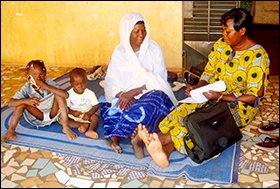
Besides security, many villages and settlements in Mali are quite remote and are often in regions that are very difficult to travel to. ORB's interviewers sometimes have to travel nearly a day through very remote areas to reach some settlements to interview.
Another challenge inherent to collecting data in Mali is the sensitivity of certain questions. As Mali has experienced a military coup recently, questions about current government leaders always need to be asked subtly. It is important that respondents feel comfortable and unthreatened giving their opinions on such questions.
While the quality of infrastructure and accommodation has improved in recent years in Mali, particularly in Bamako, travelling to Mali to train interviewers presents its own unique challenges from a Western perspective. Terrorist activity by militants is always a real possibility, particularly with the general rise in militant activity across the Sahel in 2013, so ORB Western staff always need to be vigilant in their hotels and while moving around town.
Though challenging, conducting survey research in Mali remains rewarding. Malians are generally a very friendly and welcoming people. Malian interviewers are always keen to talk to ORB western staff about life in the US or the UK and are always curious to see what we think of their country. So despite the hurdles, we believe that the surveys we conduct give average Malians a voice that allows their opinions to be known.
Work for ORB! - currently hiring for the UK office.