>> INTRO>> EUROPE>> NORTH AMERICA


Updated December '08
Both ACNielsen and MasterCard survey consumer confidence in the whole region every six months. The Bayt.com Consumer Confidence Index surveys across the GCC, Levant and North Africa regions on a quarterly basis, and The Xinhua Finance eziData China Consumer Confidence Index provides monthly ratings across the eastern, middle and western parts of China. These studies allow for comparison between countries in the region, and ACNielsen also provides comparisons with Europe and America.
Roy Morgan Research provides monthly consumer confidence indexes for Australia, and twice-monthly ratings for New Zealand.
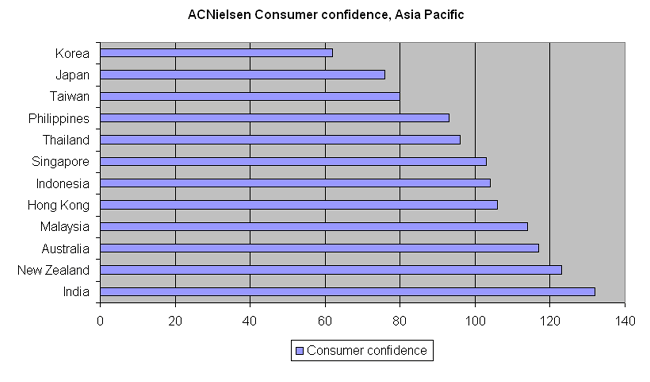
ASIA PACIFIC - ACNielsen Global Online Consumer Confidence Survey
Latest results (June 2008)
Consumer confidence worldwide has fallen to its lowest level in several years, to 88 - down six points in the last six months – the largest single drop the Index has recorded in the last three years. The Index fell three points in Asia Pacific.
India topped global rankings as the most optimistic nations, while in the last 12 months, consumer confidence in Japan, the world's second-largest economy, plunged 19 points In April.
New Zealand also dropped a staggering 18 points in the last six months - its lowest level in a decade mainly due to interest rates, which have skyrocketed to 8.25%. Over half (53%) of New Zealanders indicate that a rise in interest rates would be their major concern in the event of a downturn in their local economy. Around 13% of Kiwis say they have no spare cash after they have covered living expenses, topping the Asia Pacific region.
Across Asia Pacific, consumer confidence in Australia (-11), Hong Kong (-9), Vietnam (-11), Singapore (-12), and the Philippines (-9) also sank significantly. In other markets across Asia, particularly Vietnam, China and Singapore, escalating inflation continues to be a concern, with 67% of consumers across the region citing inflation as their biggest concern in the event of an economic downturn.
A high 89% of Japanese believe their job prospects are either not so good or downright bad, mirroring their bottom league ranking in global consumer confidence.
The world’s most avid savers have always hailed from Asia Pacific, where an average of 57% of consumers choose to build their nest eggs. The top 10 saving countries are all from this region, with Singapore (69%), the Philippines (65%) and Thailand (65%) leading the charge.
A high 89% of Japanese believe their job prospects are either not so good or downright bad, mirroring their bottom league ranking in global consumer confidence.
The world’s most avid savers have always hailed from Asia Pacific, where an average of 57% of consumers choose to build their nest eggs. The top 10 saving countries are all from this region, with Singapore (69%), the Philippines (65%) and Thailand (65%) leading the charge.
Methodology
The six-monthly survey is conducted online with 26,000 regular Internet users in 48 markets across Europe, North and South America, and Asia Pacific.
More
details
ASIA
PACIFIC
-
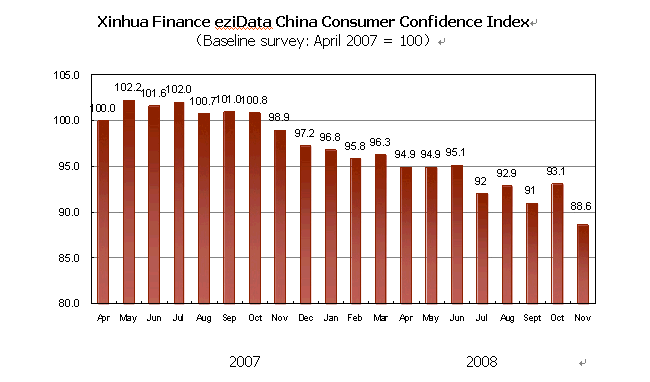
The Xinhua Finance eziData China Consumer Confidence Index (CCCI)
Latest
results
(26 November 2008)
China consumer confidence declined by 4.5 points to 88.6 in November. At the same time, mid-long term business outlook rose 3.8 points to 146.8 after two months’ consecutive drop, indicating that consumers were inspired by the program of RMB 4 trillion initiated by the government to stimulate economy, and regained confidence in the future of the Chinese economy.
Overall consumer confidence index on investment inched up 0.3 points to 86.3 in November, the first improvement in the index since October 2007. The economy-stimulating program of RMB 4 trillion did help raise consumers’ future outlooks on the stock market – sentiment on one-year stock market expectation rose 2.6 points to 104.2 after three months’ stagnation at low levels, indicating cautious optimism on the stock market on the part of the consumers.
Consumer satisfaction on current general prices rose another 1.4 points to 83 in November following a 12.4-point surge in October, getting very close to the level of April 2007 when the survey first started. Apparently consumers sensed that inflation is going away quickly and that a possible deflation is approaching.
Methodology Xinhua Finance eziData China Consumer Confidence Index is produced in association with Dr Richard Curtin, Research Professor and Director of the Consumer Sentiment Surveys at the Institute of Social Research, University of Michigan. The index is based on a monthly survey of around 1,500 Chinese households via stratified random sampling in 50 representative cities across East, Middle and West China using the same methodology as is used by the University of Michigan. All data is collected via computer assisted telephone interviewing (CATI). Index of April 2007 survey is set as the benchmark (100).
More details
ASIA
PACIFIC
-
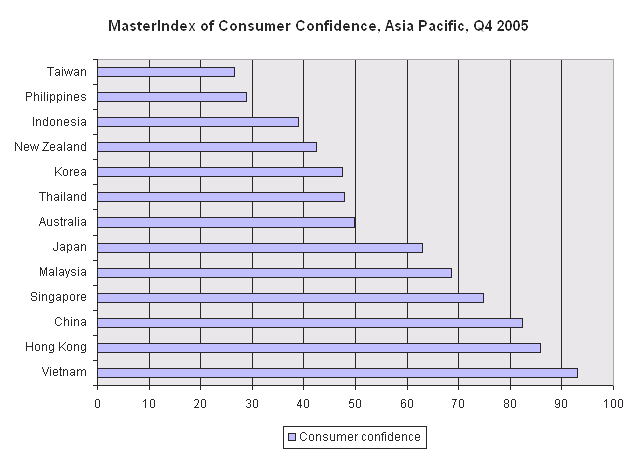
MasterCard MasterIndex of Consumer Confidence, Asia Pacific
Latest
results
(fourth quarter 2008)
The Asia/Pacific Region's consumer outlook (47.4) has for the first time since the 1997/1998 Asian Financial Crisis become pessimistic and falls significantly below Period Ago (55.0), Year Ago (67.3) and the Region Historical Average (60.0).
The Region's consumers are currently pessimistic on four of the five MWICC Economic Factors. They are pessimistic about Employment (41.2), Economy (42.1), Quality of Life (44.0) and the Stock Market (45.5).
The four markets that are optimistic in this 4Q 2008 MWICC are: Vietnam, China, India and Singapore
Vietnam (88.1) continues as very optimistic as they had been since its inclusion in the MWICC in 4Q 2003. Consumers confidence thus far appears euphoric and unperturbed (probably due to becoming a successful market economy after years of deprivation).
China (76.6) that just emerged from its two recently held Olympics continues to demonstrate strong consumer confidence over the next six months and remains as one of the consistently optimistic markets in the Region. However, signs of faltering sentiments are starting to emerge in Beijing and Shanghai while Guangzhou continues to gather strength.
India (63.9) and Singapore (62.3) are somewhat optimistic but much less so that than Period Ago and Year Ago due to a significant decline in sentiments on all MWICC Economic Factors, especially Indian's expectation for Employment and Singaporean's loss of confidence in the Stock Market.
All other markets - Hong Kong, Philippines, Indonesia, Malyasia, Taiwan, South Korea, Thailand, Japan and New Zealand - are pessimistic about the next six months.
Methodology The survey is conducted every six months among a sample of 400+ consumers in each of the 13 markets listed above. It is based on responses to questions about five issues: economic factors, employment, economy, regular income, stock market, and quality of life. It measures consumers' views about the forthcoming six months. The index has a range of 0 to 100. A score of 50 denotes a neutral situation, while anything above 50 denotes optimism.
More
details
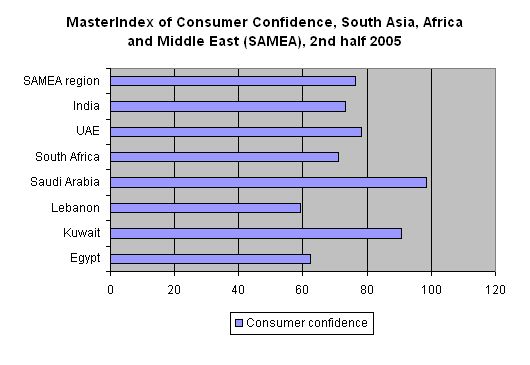
SOUTH ASIA, MID EAST, AFRICA - MasterCard MasterIndex of Consumer Confidence, South Asia, Africa and Middle East (SAMEA)
Latest results (first half 2008) Six of the eight markets surveyed were optimistic about the next six months. These include the four Gulf Markets; UAE (85.4), Qatar (88.6), KSA (80.1) and Kuwait (89.4) with India (82.1) and South Africa (74.3) making up the rest. Two markets namely: Egypt (32.3) and Lebanon (32.0) were rather pessimistic.
The SAMEA region as a group of markets (70.6) remains fairly optimistic about the next six months even though consumer sentiments are a bit weaker than the last period (78.4), a year ago (79.3) and its historical average (76.4).
Kuwait (89.4), Qatar (88.6) and United Arab Emirates (85.4) represent the top three performing markets in this 1H 2008 MasterIndex. Next comes India (82.1), Saudi Arabia (80.1) and then South Africa (74.3) trailed by Egypt (32.3) and Lebanon (32.0). As with the current SAMEA region Index, all markets except the UAE witness a softening of consumer sentiments. (Qatar has no back data for comparison.)
Amidst a softer outlook in the Region, ME & L and in most markets, United Arab Emirates (85.4) emerges as the only market with stronger consumer sentiments than the last period (78.5) and a directionally more positive outlook than its historical average (83.2).
Methodology See MasterIndex Asia Pacific, above.
More
details
MIDDLE EAST - Bayt.com Consumer Confidence Index
Latest results (27 August, 2008) Consumer Confidence dropped for the second time this year in the UAE falling 8.2 points, following what has been an overall bad year in terms of consumer confidence.
Countries around the GCC region however fared relatively better than the UAE in terms of consumer confidence, with an increase of three index points in Kuwait, with minor decreases in Qatar by 0.3 index points followed by KSA with a drop of 2.1 index points, and a drop in Bahrain by 4.9 index points.
North African countries also saw dips, with consumer confidence dropping by 7.6 points in Morocco, 2.7 points in Algeria and 1.9 index points in Egypt. The Levantine countries fared considerably better, with improvements in Syria and Lebanon of 11.4 and 7.9 index points respectively.
Consumer expectations and optimism towards the future, the survey found, dropped considerably in the UAE, falling by 9.8 points since the previous quarter. In comparison, Kuwait recorded a marginal dip of 0.3, while KSA and Bahrain noted decreases of 1.9 and 4 points respectively. Qatar remained the only Gulf country to feel an improvement, with an increase of 2.3 index points.
Optimism for the future in terms of their country's economy remained relatively low from respondents across all countries, with 35% believing their economy will deteriorate. There were general feelings of optimism however regarding how people feel their financial positions would change in a year's time, with 46% feeling they would be better off. Most optimistic were residents of Gulf states Kuwait and Qatar, with 55% and 52% anticipating better finances after a year in addition to 55% of Pakistan's respondents.
The index additionally reveals how respondents rate the current economic climate in terms of whether it's a good, neutral or bad time for buying consumer goods. The majority of respondents at 40% agreed it was a bad time to buy, which marks a slight increase on the last wave's 38%. Across the surveyed countries, Morocco, followed by the UAE, recorded the greatest decreases in the Propensity to Consumer Index falling by 11.6 and 5.8 points each. Syria and Lebanon recorded phenomenal boosts in terms of spending power, moving up the index by 17.4 and 13.2 points as compared to the previous wave. That Syria and Lebanon showed such marked improvements may indicate the greater political, economic and social stability actuated recently.
Methodology Polling firm YouGovSiraj launched the index in partnership with Dubai-based job site, Bayt.com. The first wave of the online survey questioned more than 12,518 people across the GCC, Levant and North Africa regions, and future surveys will be conducted on a quarterly basis.
More details
NEW ZEALAND - Roy Morgan Consumer Confidence Rating
Latest results (4 December, 2008) The early December NZ Roy Morgan Consumer Confidence rating is up 5.9 points to 105.6. The rating is now 21.3 points below the 126.9 it was in early December 2007. This rating was conducted November 17-30, after the General Election victory of John Key and prior to the decision by the Reserve Bank of New Zealand to slash interest rates by a record 1.5% to 5.0%.
The strong rise in the New Zealand Roy Morgan Consumer Confidence rating has been driven by both an increasing number of New Zealanders saying now is a good time to buy major household items and also more positive feelings amongst New Zealanders about their family’s financial situation compared to a year ago.
Retailers should breathe a little more easily for Christmas as now 45% (up 8%) of New Zealanders say now is a good time to buy major household items, level with the 45% (down 6%) of New Zealanders that say now is a bad time to buy — both figures haven’t been at these levels since mid-September 2008.
New Zealanders are also far more positive about their personal financial situation compared to a year ago with 39% (up 7%, and the highest since the beginning of March 2008) of New Zealanders saying their family is better off financially than a year ago compared to 33% (down 10%), saying their family is worse off.
Looking further ahead New Zealanders are increasingly confident with 51% (up 5%) of New Zealanders expecting good times for the country during the next five years while only 26% (up 1%) expect bad times.
Over the year ahead New Zealanders are generally positive about their own family’s financial situation with 50% (down 2%) expecting to be better off financially in a year’s time compared to just 22% (up 2%) that expect their family to be worse off financially.
In terms of the country as a whole though, New Zealanders are still expecting tough times through most of 2009 with 56% (up 2%) expecting bad times economically for the country as a whole over the next twelve months while only 26% (unchanged) expect good times.
Methodology The rating was conducted across New Zealand by telephone with a cross section of 1,002 people aged 14 and over.
More
details
AUSTRALIA - Roy Morgan Consumer Confidence Rating
Latest results (11 December, 2008)
On December 6/7, 2008 the weekly Consumer Confidence rating was virtually unchanged at 98.4 (up 0.6pts). The small rise came after a widely anticipated interest rate cut of 1% by the RBA on Tuesday December 2.
The small rise in the rating has been primarily driven by Australians feeling more comfortable about buying major household items.
Now 40% (up 1%, and the highest figure since February 2008) of Australians say now is a good time to buy major household items while 33% (down 3%, and the lowest figures since the bankruptcy of Lehman Brothers on September 15) of Australians say now is a bad time to buy.
Comparing their family’s financial situation with a year ago, 27% (unchanged) of Australians say their family is better off financially than a year ago while 36% (also unchanged) of Australians say their family is worse off.
Looking to the future, 34% (down 2%) of Australians expect their family to be better off financially in a year’s time while just 20% (unchanged) say that they expect to be worse off.
Australians are still very worried about the economic situation for the country over the next 12 months, with 46% (down 1%), expecting bad times for Australia, while just 18% (unchanged) of Australians now expect good times.
Australians are more positive over the longer-term than short-term with 29% (down 2%) of Australians expecting continuous good times for Australia over the next five years compared to 22% (down 1%) of Australians expecting bad times.
Methodology This rating is based on 1,176 face-to-face interviews conducted Australia-wide with men and women aged 14 and over.
More details
|