>> INTRO>> NORTH AMERICA>> ASIA PACIFIC


Updated December '08
The European Commission conducts a monthly Europe-wide confidence survey with indexes for the EU, the Euro currency area, and individual countries. The ACNielsen index provides ratings for the whole of Europe once every six months.
There are also individual surveys for various countries. The surveys for France and Italy use a similar methodology, providing comparable data, while the TNS Nationwide index for the UK is based on the methods used by the long-standing US Conference Board consumer confidence index. GfK conducts monthly surveys for both the UK and Germany.
EUROPE WIDE - ACNielsen Consumer Confidence Index
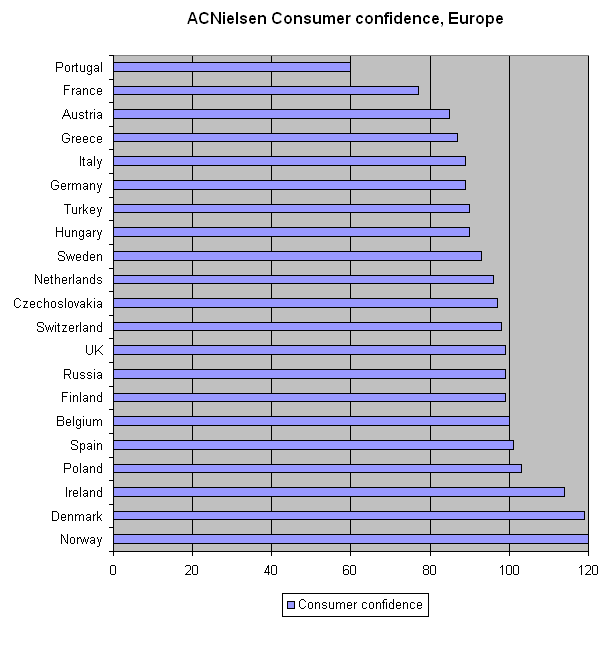
The latest Nielsen Consumer Confidence Index has plunged to 88 - down six points in the last six months – the largest single drop the Index has recorded in the last three years.
IIn Europe, the Index dropped six points to 83, with Norway the most optimistic nation in the region with a score of 129. Confidence in Norway did take a six-point dive in the six months to April, but this pessimism may not last long, as a recent estimate released by the Norwegian government reveals that for every NOK 10 increase in the price for oil, Norway will earn an extra NOK 6.1 billion. This means Norway stands to gain an extra NOK 100bn (approximately US$19.3bn) from oil exports alone.
Other European countries posting an increase in consumer confidence were the Netherlands (+5%), Poland, Czech Republic (+3%), and Belgium (+1%). Consumer confidence remained unchanged in Germany.
In Western Europe, consumer confidence took the biggest tumble in Spain (down 16 points) and the UK (down 15 points). In the last twelve months, Spain has suffered the biggest fall in consumer confidence globally, with a drop of 24 points. Consumer confidence in Italy, which suffered the biggest drop in consumer confidence in the previous survey, fell a further four points from 80 to 76 points. Nine in 10 Italians believe their nation is currently in recession.
A staggering 93% of Portuguese believe their job prospects are either not so good or downright bad. In contrast, 94% of Norwegians are optimistic about their job prospects over the next year.
One in five (26%) Portuguese, Belgians, Germans and French said they have no spare cash along with 22% of UK consumers.
The Nordic nations of Denmark (50%), Norway (46%) and Finland (45%) - countries that have always topped the Consumer Confidence Index for their optimism - are most expectant that the world will be plunged into a global recession in the coming year.
Methodology The six-monthly survey is conducted online with 26,312 consumers across Europe, Asia Pacific, North America and the Middle East. The latest six-monthly survey was conducted from October to November 2007 with users in 48 markets.
>> More details
|
EUROPE WIDE - European Commission Business and Consumer Surveys
Latest results (27 November 2008) Consumer confidence declined only marginally, but remains at very low levels compared to its average value.
Sentiment in the retail sector declined further in the EU, but remained the same in the euro area.
Reflecting the widespread deterioration in economic sentiment, all EU countries reported weakening sentiment. Among the large Member States, confidence in the UK fell the most (-8.8 points), followed by Poland (-7), Germany (-6.3) and the Netherlands (-5.4). The confidence indicator fell less significantly in France (-1.3), Italy (-1.2) and Spain (-2.8); however the latter now stands at its lowest ever.
Methodology The indicator is based on a monthly survey conducted across the countries of the European Union (EU) and those in the Euro currency area (EA), with a total sample size of more than 32,000. It is based on answers to questions about expectations of the financial situation of households, the general economic situation, the unemployment situation and savings.
>> More details
|
|
FRANCE - Insee Monthly Consumer Confidence Survey
Latest results (26 November 2008) French consumer confidence was recovered slightly in November, rising to -43 in November from -46 in October.
Households' view on opportunities of making major purchases was almost stable, but they were more worried about future unemployment with outlook for unemployment rising to 74 points in November against 68 in October.
Personal financial situation outlook moved up to -19 from -22, while business confidence fell to 80 in November from 87 in October, which was considered as the lowest since September 1993.
French consumer confidence is currently at its lowest since 1972. Consumer confidence in the country peaked at -13 in June 2007, the highest reading since 2003.
Methodology The Insee monthly index covers all goods and services consumed on French territory by resident households and non-resident households (for example, tourists).
>>
More
details
|
GERMANY - GfK Consumer Climate MAXX survey
Latest results (22 December 2008)
In spite of the financial crisis and its impact on the economy, German consumer propensity to buy was again up slightly in December. The overall indicator is forecasting a value of 2.1 points for January 2009 after a revised value of 2.1 points for December and consequently remains stable. However, both income and economic expectations declined.
Consumer propensity to buy remains constant at the start of the new year, albeit at a low level. Reduced production, cuts in working hours and announcements of potential redundancies are increasingly leading to consumers feeling themselves to be personally affected by the crisis. For the first time after four consecutive rises, December has seen a perceptible decline in income expectations.
The downward trend in economic expectations is likely to last until the end of the year. The decline is currently running at -2.3 points down from November, signaling a further moderate decline in the indicator, which now stands at -32.4 points.
Forecasts for 2009 have been significantly downgraded, and the experts are assuming that the German economy will shrink.
Income expectations have dropped 8.5 points to their current level of just -15.4 points. The decline in the economy is leading growing numbers of those in employment to fear for their jobs and consequently, to be more pessimistic in their assessment of their own financial position. Anxieties concerning loss of income are currently taking precedence over factors which tend to increase purchasing power, such as lower petrol and heating oil prices.
Unlike income expectations, the propensity to buy remained stable at the end of the year. Up 0.4 points, it even rose slightly. The indicator currently stands at -6.3 points, which is still below its long term average of 0 points.
The overall indicator is forecasting 2.1 points for January after the revised value, also 2.1 points, for December and with this, the indicator has remained constant.
Methodology The survey, conducted each month on behalf of the European Commission, involves 2,000 consumer interviews. There are separate indexes for income expectations, economic outlook, consumption and buying propensity, as well as an overall consumer climate measure.
>>
More details
|
ITALY - ISAE Monthly Consumer Survey
Latest results (25 November 2008) Italian consumers’ confidence continued to decline in November, reaching 100.4, compared to 102.2 in the previous month.
The deterioration was particularly sharp for the general economic situation. The related indicator lowered from 78 (in October) to 72.5, the lowest level since March 1994.
The gauge for the future situation declined from 93.3 to 95.9, while the one covering the sole current conditions moved from 105.1 to 104.6.
In contrast, the respondents’ opinions on their personal situation improved (from 112.3 to 113.7), mainly thanks to slightly less negative indications regarding savings and the family budget.
However, consumers were highly concerned about the labour market and showed marked pessimism regarding their personal situation and the country’s general economic conditions.
The consumer durables market remained basically stable at a low level and, lastly, respondents continued to downsize their perception of inflation.
Consumers expressed strong concerns about all variables. Italy's general economic situation was considered to have sharply deteriorated and was not expected to improve in the following twelve months.
Methodology Each month, ISAE surveys 2,000 Italian consumers about their assessments and forecasts on the Italian economic situation, households' economic situations, employment and spending intentions.
>>
More details
|
UK - GfK NOP Consumer Confidence Barometer
Latest results (December 2008) The index has risen by two points to -33, nineteen points lower than this time last year. This marginal improvement has been caused by an improvement in the major purchase measure.
Confidence in the 'major purchase measure', such as furniture or electrical goods, has seen an improvement of ten points - but is still fifteen points lower than this time last year.
Confidence in the general economic situation over the next 12 months measure has dropped five points.
Confidence in the ‘now being a good time’ to save measure has dropped twelve points to -8.
The index measuring changes in personal finances during the last year improved by two points to a score of -15; this is fourteen points lower than this time last year. The forecast for personal finances over the next year has remained the same with a score of -10. This is eighteen points lower than December ’07.
The measure for the general economic situation of the country during the last twelve months has dropped by one point to a score of –72; this is thirty-six points lower than this time last year. Expectations for the general economic situation over the next twelve months have dropped by five points to -41; fifteen points lower than December ’07.
Methodology Around 2,000 adults are interviewed monthly.
>> More details
UK - TNS/Nationwide Consumer Confidence Index (NCCI)
Latest results (3 December 2008) The index fell again this month, despite falling fuel and food costs and a substantial reduction in the Bank of England base rate. Reports that the UK is now in a recession, increased unemployment and continued financial market instability have almost certainly had a significant impact on consumer confidence in November.
The only index to see a rise this month was the Spending Index, which increased from 56 in October to 64 in November. This is, however, more likely to reflect consumers' observations of lower prices rather than their intention to buy.
Confidence in the current economic and labour markets fell to 30 during the month, while the Expectations Index fell to 63 in November, perhaps driven by the realisation that a rapid turnaround in the economy and labour market is unlikely.
Spending confidence improved during the month, probably driven by heavy discounting on the high street as shoppers start to prepare for Christmas. Just over a quarter (26%) believe now is a good time to make a major purchase, an 8% increase from last month. 58% of consumers believe now is a bad time to make a major purchase, compared to 66% in October.
Consumers remain concerned about the economy as they come to terms with the current financial turmoil. More than three quarters (76%) believe the current economic situation is bad, compared to 75% in October while 9% believe that the current economic situation is good, compared to 8% in October.
Sentiment towards the future economic situation is likely to have been impacted by consumers' realisation that it may be some time before we see a turnaround in the economy. Nearly half (45%) believe that the economic situation will be worse in six months time, compared to 38% in October. Under a quarter (22%) of consumers believe the economy will be better in six months time, compared to 27% last month.
Nearly half (49%) of consumers think there are few jobs available now, up from 41% last month. Looking forward, over half (59%) think there will be few jobs available in six months, up from 56% in October.
Nearly a third (31%) believe there are not many or few jobs available today and 47% now think that there will be not many/few jobs available in six months' time compared to 42% in July.
Methodology The survey is modelled on the US Conference Board consumer confidence survey. Based on 1,000 nationally representative interviews each month, it measures views of the general economic situation and employment conditions, as well as personal expectations for now and six months' time. The baseline figure of 100 represents the level of consumer confidence in May 2004.
>> More details
|